Akanksha Sharma 2026-07-01
A practical guide to understanding EVA grades, material properties, and supplier selection.
We have always believed that good manufacturing is not only about making products. It's about making the right decisions, and one of them is material selection.
Over the years, Rajshila worked closely with leading manufacturers across industries and learnt that every product comes with its own performance expectations. Some demand superior cushioning, while others require flexibility, durability, insulation, weather resistance, or long-term reliability.
It's no surprise that manufacturers often turn to ethylene vinyl acetate when an application demands the right balance of flexibility, cushioning, durability, and processability. However, EVA is available in a wide range of grades, each engineered to meet specific performance requirements. This versatility has made EVA a preferred material across diverse EVA industrial applications, including footwear, sports and fitness equipment, electronics, wire & cable, packaging, protective products, and solar modules.
Which also means one important point.
Not every EVA grade is right for every application.
The better you understand the material, the easier it becomes to choose the right grade, work with the right EVA suppliers, and build products that perform exactly as expected.
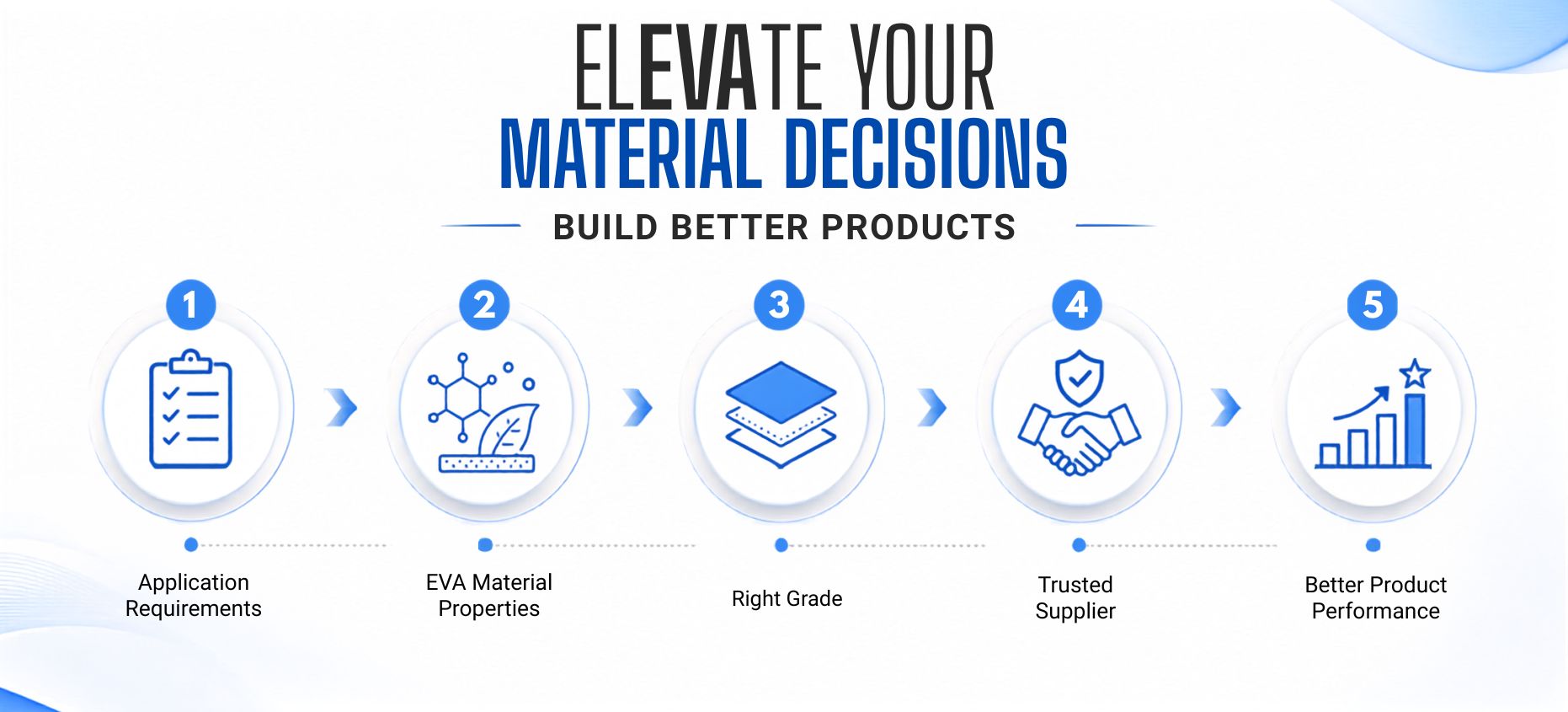
Manufacturers don't choose a material simply because it's popular in the industry. Their choice is based on how effectively it solves manufacturing challenges and adds value throughout the product lifecycle.
Over the years, EVA has earned that trust by adapting to different manufacturing needs. It enables manufacturers to achieve different performance goals without completely redesigning the product or changing the production process. This adaptability is one of the key reasons manufacturers continue to choose EVA.
As a result, EVA applications today extend across industries where consistency, processability, and long-term performance are equally significant. Some of them are as follows:
While all these industries rely on EVA, they don't rely on the same grade. Every application demands a different combination of properties, which is why EVA comes in multiple grades.
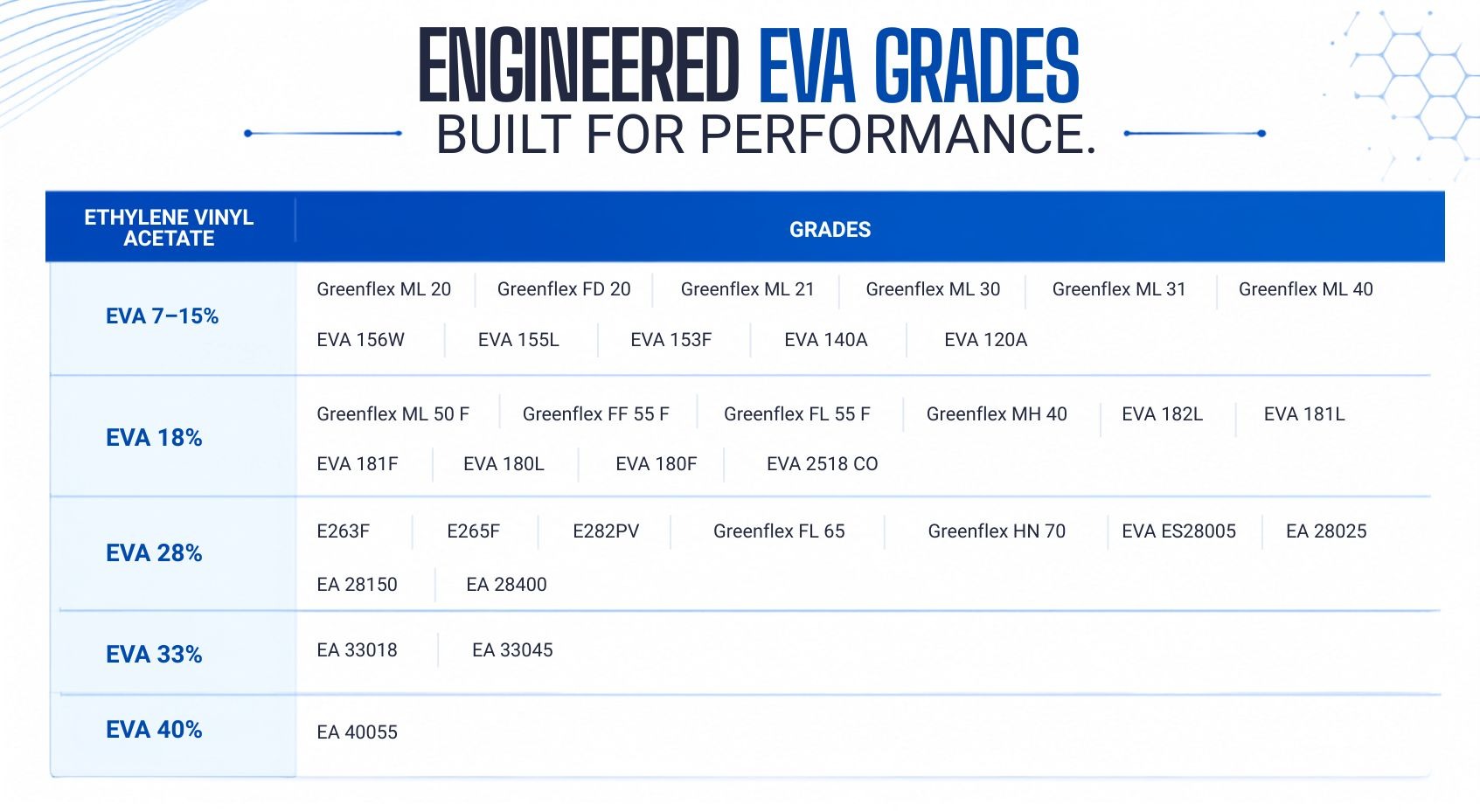
And that's where understanding EVA material properties becomes an important topic to discuss.
Before moving any further, let's first address one of the biggest misconceptions about EVA.
It isn't a single material with fixed properties.
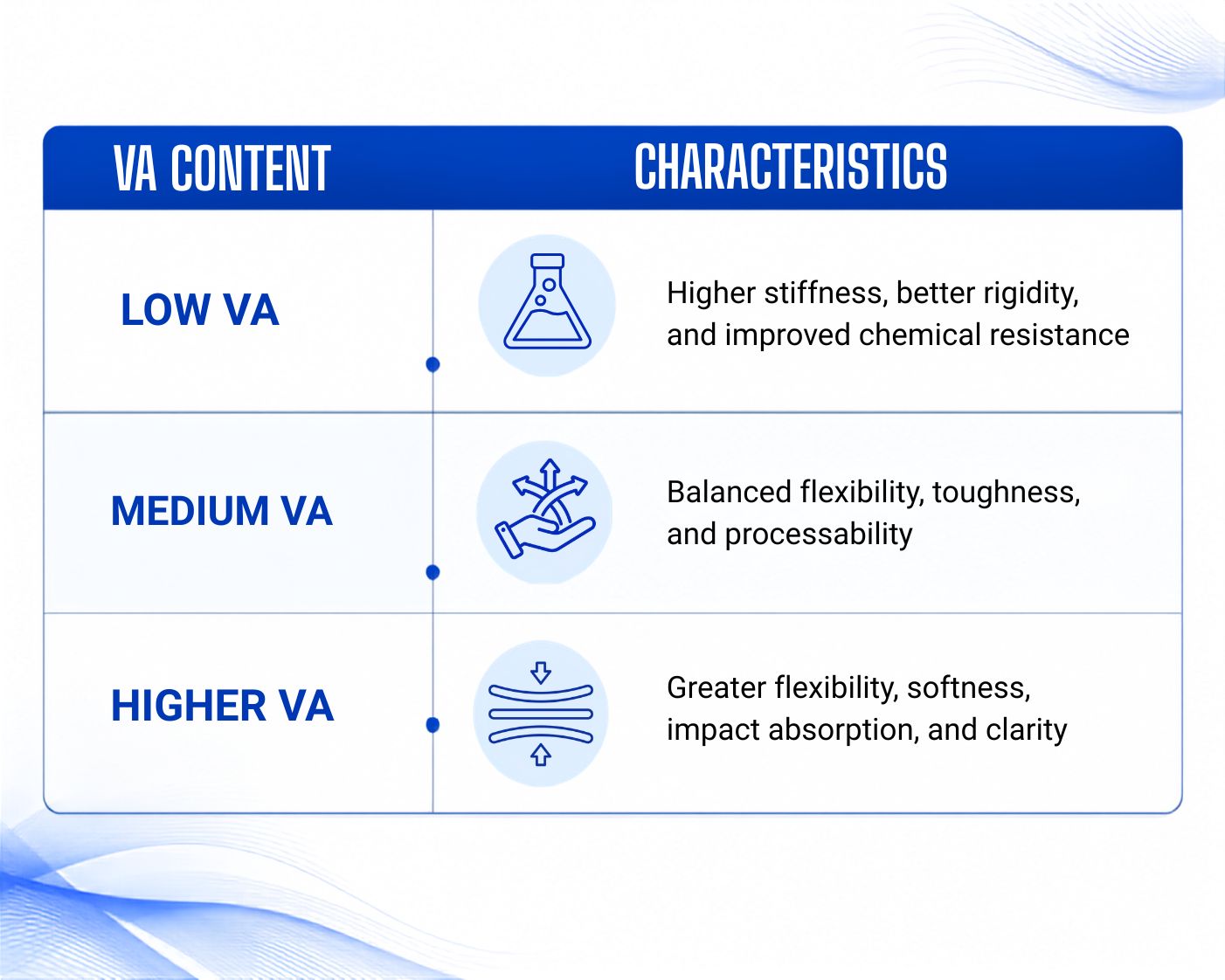
In reality, EVA is a family of copolymers whose characteristics can be tailored by adjusting its composition, particularly the percentage of vinyl acetate (VA). As the VA content changes, so do the material's characteristics. Flexibility, softness, toughness, clarity, and processability all vary depending on the composition.
This is why an EVA grade developed for lightweight cushioned footwear may not deliver the same performance in wire & cable insulation or hot-melt adhesive applications. The material family remains the same, but the grade changes to suit the application's performance requirements.
Although the exact properties also depend on factors such as molecular weight, formulation, and additives, the table below illustrates how changes in vinyl acetate (VA) content generally influence EVA material properties.
There isn't one "best" EVA grade. The right grade depends on your application's requirements. So, instead of asking, "Which EVA is the best?", ask, "Which EVA grade is best suited for my application?"
With over 40 years of industry expertise, we at Rajshila believe that choosing the right EVA grade starts with understanding your product's needs and performance requirements. Once you're clear about what your product demands, selecting the right grade becomes much easier. After all, every application performs under different conditions and comes with different expectations.
Here's a simple way to look at it:
Although all these products may reflect ethylene vinyl acetate properties, they don't use the same grade. Choosing the right grade helps match the material's properties to your product's specifications.
If you're still unsure, ask yourself these questions before selecting an EVA grade.
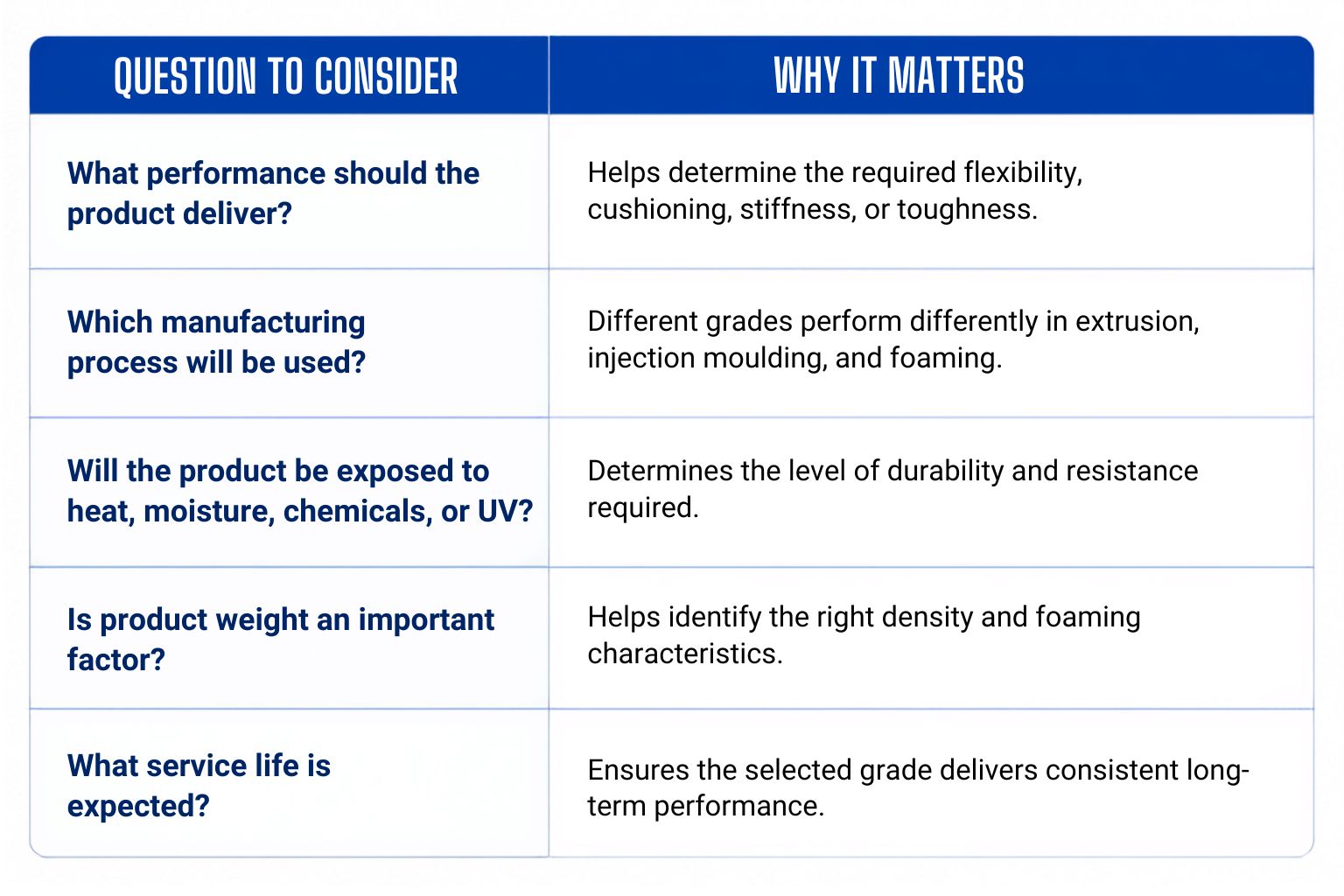
Over the years, we’ve found that manufacturers who consistently produce quality products have one thing in common: they never compromise on the foundation. They begin with certified materials, the right grades, and a supplier they can trust. So before making your next purchase, ask yourself: Do you have the right EVA supplier? And does your supplier offer:
At Rajshila, we've spent over four decades working closely with manufacturers across industries. Our technical expertise, strong supplier partnerships, market insights, and personalised solutions help businesses choose the right EVA grades for applications ranging from footwear and yoga mats to industrial components and specialised products.
We believe in delivering raw materials that shape remarkable creations.
Have questions beyond this blog? Contact Rajshila to learn more about ethylene vinyl acetate's properties, grades’ availability, recyclability, processing techniques, and more.
Related blogs


Rajshila Synthetics Pvt. Ltd. 116-117, 1st Floor, NDM-2 Plot D1,D2,D3 Wazirpur Distt. Center, Netaji Subhash Place, Delhi 110034